Shaping leaders and toppers since 2009
Expert Faculty
Our experienced and knowledgeable instructors have a proven track record of helping students succeed in various competitive exams. With their personalized guidance, you’ll understand even the most complex concepts with ease.
Comprehensive Study Material
We provide well-structured and updated study material, ensuring that you have all the resources you need to prepare effectively. From theory notes to practice papers, everything is designed to enhance your learning experience.
Result-Oriented Approach
We focus on helping you achieve results, not just learn. Our courses are designed with your success in mind, incorporating targeted strategies to maximize your performance on exam day.
Interactive Learning Environment
Our classes are engaging and interactive, encouraging you to actively participate and ask questions. This collaborative environment fosters better understanding and retention of concepts.
Mock Tests and Assessments
Regular mock tests and assessments help you gauge your progress and identify areas for improvement. You’ll feel fully prepared for the real exam with our simulated test environments.
Flexible Learning Options
Whether you prefer in-person classes or online sessions, we offer flexible learning options to suit your schedule and convenience. Study at your own pace with access to recorded lessons and resources.
Personalized Attention
We understand that every student is unique. Our small batch sizes and personalized mentoring ensure that you receive individual attention and support, helping you overcome any challenges you may face.
Proven Success Record
Our students consistently rank among the top scorers in competitive exams, and many have successfully secured their desired institutions or job positions. Join us to be part of this legacy of success.
Join us today and take the first step towards your success!

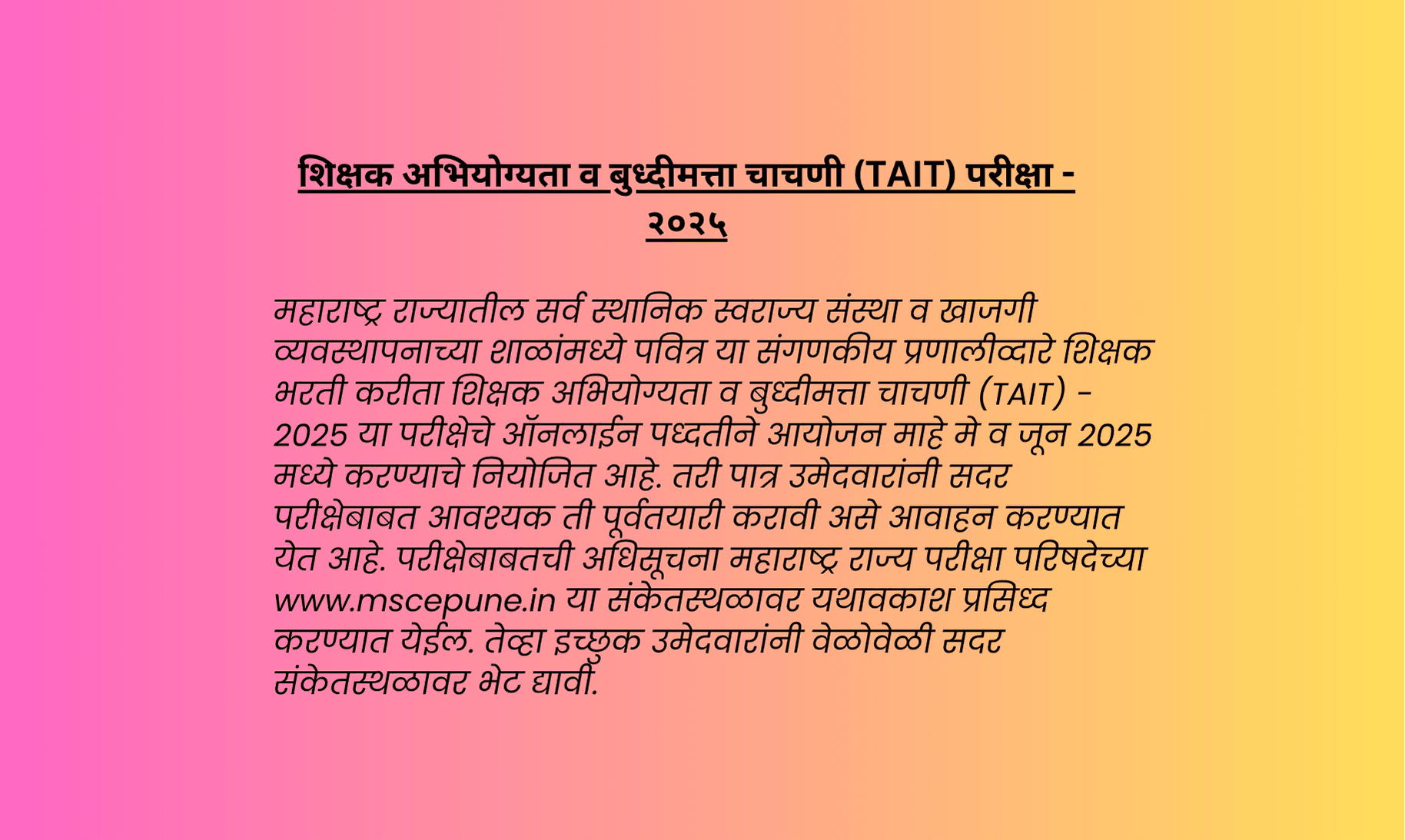
TAIT
TAIT Exam Syllabus 2025
Key Information about NDA Exam:
Age: Candidates must be between 16.5 to 19.5 years old at the time of commencement of the course.
Educational Qualification:
For Army Wing: 10+2 in any stream.
For Navy and Air Force Wings: 10+2 with Physics and Mathematics.
Gender: Only male candidates can appear for the NDA exam (as of now).
Nationality: Must be an Indian citizen or a subject of Nepal or Bhutan.
Exam Stages:
Written Exam: The written test is divided into two parts:
Mathematics: 300 marks
General Ability Test (GAT): 600 marks (includes English, General Knowledge, Physics, Chemistry, etc.)
SSB Interview: Candidates who qualify the written exam are called for the Services Selection Board (SSB) interview, which tests psychological aptitude, intelligence, and physical fitness.
Medical Examination: Candidates must be medically fit as per the standards set by the NDA.
Pattern of the Exam:
Mode: The exam is conducted in offline mode (pen and paper-based).
Duration: 2.5 hours for each paper (Mathematics and GAT).
Negative Marking: 1/3rd mark is deducted for every wrong answer.
Selection Process:
Written Exam: You must clear both the Mathematics and General Ability Test.
SSB Interview: Those who clear the written exam will be called for a 5-day SSB interview.
Final Merit List: Based on the written exam score, SSB interview, and medical fitness.
Training at NDA:
After clearing the NDA exam, successful candidates undergo 3 years of training at the National Defence Academy, Khadakwasla, Pune.
Training includes academic courses, physical fitness, and military training.
Important Dates:
The NDA exam is held twice a year (usually in April and September).
Application: Applications are usually opened around January/June.
Why Take the NDA Exam?
A career in the Indian Armed Forces is prestigious, honorable, and fulfilling.
NDA provides opportunities to serve the nation while enjoying excellent benefits, allowances, and a structured career path.
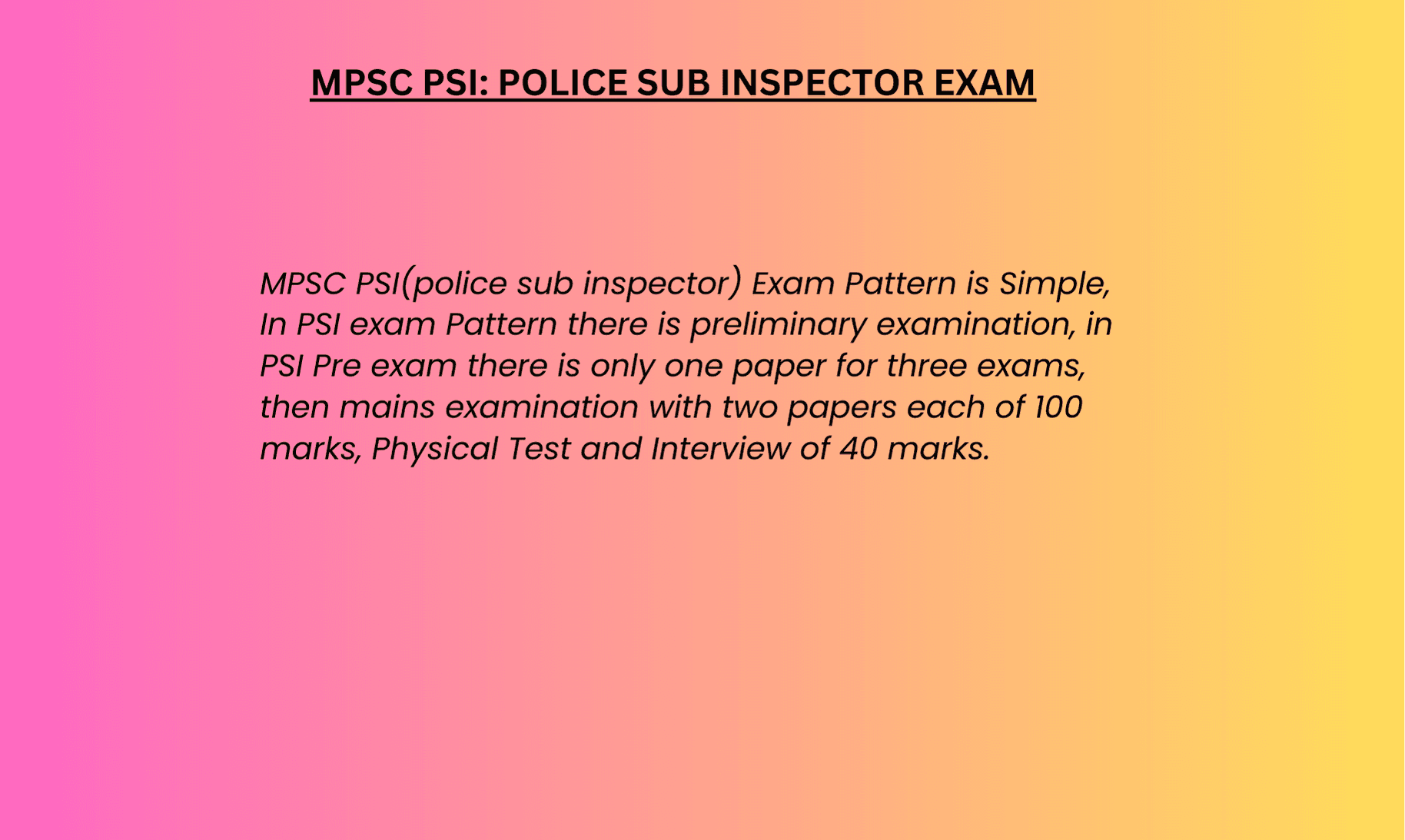
Key Information about PSI Exam:
Age: Typically, candidates must be between 19 and 28 years of age. Age relaxations may apply for reserved categories.
Educational Qualification: A candidate must have a graduation degree from a recognized university (typically in any discipline).
Physical Fitness: Candidates must meet certain physical standards in terms of height, weight, and chest measurements. The specific criteria can vary by state.
Nationality: Indian citizens.
Exam Pattern: The PSI exam usually consists of the following stages:
Preliminary Exam: This is a screening test that includes multiple-choice questions (MCQs) based on General Knowledge, Current Affairs, Reasoning, and other subjects.
Main Exam: If you qualify the preliminary exam, you proceed to the Main Exam. This includes:
Written Examination: Questions on general studies, law, and police subjects.
Physical Efficiency Test (PET): A fitness test to assess physical endurance and strength.
Physical Standard Test (PST): Evaluates the height, chest, and weight according to the set standards.
Interview/Personality Test: Candidates who clear the written exam and physical tests are called for an interview to assess their personality, communication skills, and overall suitability for the role.
Exam Subjects: The subjects for the written exam can vary by state, but commonly include:
General Knowledge & Current Affairs (including history, geography, economics, politics, and sports)
Logical Reasoning and Analytical Ability
General Hindi and English
Indian Penal Code, Criminal Procedure Code, and Evidence Act
Police Procedures and Laws (sometimes included in the syllabus)
Physical Fitness Standards: The PSI exam has strict physical requirements:
For Male Candidates:
Minimum height: 165 cm
Chest (unexpanded): 79 cm
Chest (expanded): 84 cm
Running: 2.4 km in a specified time (usually around 12-15 minutes).
For Female Candidates:
Minimum height: 155 cm
Running: 1.6 km in a specified time (usually around 10-12 minutes).
Physical standards can vary by state, so candidates must check specific state requirements.
Selection Process:
Preliminary Exam: A screening test with multiple-choice questions.
Main Exam: A detailed written exam followed by physical tests.
Interview: A final round of assessment based on personality, suitability for the role, and communication skills.
Medical Examination: Successful candidates must pass a medical check-up to ensure fitness for the job.
Salary and Benefits:
PSI officers enjoy a good salary package with various allowances like travel, medical, and dearness allowances.
The salary typically ranges from ₹35,000 to ₹45,000 per month, depending on the state and experience.
Officers also receive various perks, including promotions and pension benefits.
Important Dates:
The PSI exam is usually conducted once a year by different state recruitment boards.
Notification for the exam is generally published on the respective State Police Department's website.
Why Take the PSI Exam?
Becoming a Police Sub-Inspector offers a prestigious career in law enforcement.
PSI officers contribute directly to maintaining public safety and security.
The job offers various career growth opportunities, including promotions to higher ranks like Deputy Superintendent of Police (DSP) or Assistant Commissioner of Police (ACP).
What Are Banking Examinations ?
Types of Banking Examinations:
IBPS Exams (Institute of Banking Personnel Selection): IBPS conducts exams for recruitment to several public sector banks. Some major exams under IBPS are:
IBPS PO (Probationary Officer)
IBPS Clerk (Clerical Cadre)
IBPS SO (Specialist Officer)
IBPS RRB (Regional Rural Banks)
SBI Exams (State Bank of India): SBI is one of the largest public sector banks in India and conducts its own recruitment exams. Key exams include:
SBI PO (Probationary Officer)
SBI Clerk (Junior Associate)
SBI SO (Specialist Officer)
RBI Exams (Reserve Bank of India): RBI, the central bank of India, conducts recruitment exams for various positions like:
RBI Grade B Officer (for managerial roles)
RBI Assistant (for clerical positions)
Private Sector Banks: Many private sector banks, such as HDFC, ICICI, Axis, and Kotak Mahindra, also conduct their own recruitment exams for various positions, often similar to public sector banks.
Key Information about Banking Exams:
Eligibility Criteria:
Age Limit: Generally, candidates should be between 20 and 30 years of age (may vary based on the exam and category).
Educational Qualification:
For PO/Clerk: A bachelor's degree (in any discipline) from a recognized university.
For Specialist Officers (SO): A relevant degree or professional qualification based on the specific post (e.g., IT, Marketing, HR, etc.).
Nationality: Candidates must be Indian citizens, or subjects of Nepal/Bhutan, or certain other categories of Indian origin.
Exam Pattern: Banking exams generally consist of two stages:
Preliminary Exam (Prelims): This is the initial screening round, which is usually an online test with multiple-choice questions (MCQs).
Main Exam (Mains): The main exam is more detailed and may also include descriptive tests and subject-specific tests (especially for Specialist Officer roles).
Common sections in these exams:
Reasoning Ability
Quantitative Aptitude
English Language
General Awareness/General Knowledge (especially banking-related)
Computer Awareness
Some exams, especially for SO positions, may have additional subject-specific sections like Marketing, IT, or Professional Knowledge.
Selection Process: The selection process typically involves:
Preliminary Exam: Online test to assess reasoning, quantitative aptitude, and English.
Mains Exam: A more comprehensive test, often with an additional section for banking knowledge, computer awareness, and sometimes a descriptive section (for PO exams).
Interview (for PO/SO positions): Candidates who clear the Mains exam are called for an interview. The interview assesses the candidate's suitability for the role, communication skills, and knowledge of banking.
Document Verification & Final Selection: After the interview, selected candidates undergo document verification before final appointment.
Salary and Benefits:
PO Positions: The starting salary is generally around ₹40,000-₹60,000 per month, which includes basic pay, allowances, and perks.
Clerk Positions: The salary is generally around ₹20,000-₹30,000 per month.
SO Positions: The salary varies depending on the role, but it is usually higher than that of a clerk, starting at around ₹40,000-₹50,000 per month for most roles.
Benefits include medical insurance, pension schemes, and allowances like HRA, DA, and more.
Important Dates:
The banking exam schedule is usually released annually. Exams for most banking positions are held once a year or twice a year.
Notifications about exam dates, application deadlines, and other details are published on the official websites of the respective conducting bodies like IBPS, SBI, or RBI.
Popular Banking Exams:
IBPS PO - For Probationary Officers in public sector banks.
IBPS Clerk - For clerical positions in public sector banks.
SBI PO - For Probationary Officers in the State Bank of India.
SBI Clerk - For Junior Associates in the State Bank of India.
RBI Assistant - For clerical positions in the Reserve Bank of India.
RBI Grade B - For managerial roles in the Reserve Bank of India.
IBPS SO - For Specialist Officers in public sector banks.
Why Take Banking Exams?
A career in banking is prestigious, offers job stability, and provides a chance to serve the public.
Banks offer a structured growth path with promotions and salary increments.
Benefits include a good salary, job security, allowances, and pension plans.
A banking career can also offer opportunities to work in various roles such as credit, marketing, human resources, information technology, and more.